
Iroquois County Release Meanings
A release entry marks the end of one custodian's control. It does not always mean a person walked into the community. The Iroquois County Jail may record bond or pretrial release, recognizance, dismissal, time served, sentence completion, probation, transfer, a writ, hospital movement, or pickup by another authority. The exact wording matters. A transfer to the Illinois Department of Corrections, another jail, the U.S. Marshals Service, or ICE is still custody, even though the person has left the county jail.
Use the booking episode as the unit of proof. Note the legal name, aliases, birth date if known, arrest date, booking number, and court case number. A later warrant or new booking does not cancel an earlier release event. It creates a new episode. Likewise, a pending case can continue after pretrial release, so an exit from jail should never be described as an acquittal unless the court record says that.
| Exit type | What it means | Next record |
|---|---|---|
| Pretrial, bond, or recognizance | Local detention ends while the case may continue | Circuit Court order and docket |
| Time served or sentence complete | The ordered local custodial term ends | Judgment, jail credit, and release entry |
| Probation | Community supervision ordered by the court | Court file and County Probation |
| Transfer to IDOC | County custody ends but state imprisonment begins | IDOC Individual in Custody Search |
| Federal or ICE pickup | Another authority takes custody | Federal court, BOP, USMS, or ICE records |
Iroquois County Release Record Fields
The 2024 state jail inspection describes unusually useful exit documentation. Before discharge, transfer, or release, jail staff verify identity and record the date, time, and authority for the event. Staff also inspect the person, inventory and return property, and document the release of maintenance medication. The person signs an itemized property receipt. The jail retains that signed receipt permanently.
A focused request should identify one booking and ask for existing records, not an explanation made from memory. Request the jail-management release screen or log entry and the booking packet. The county has not promised that every field below is public in every matter. Exempt material may be redacted, but the requester can ask for all reasonably segregable fields.
| Field | What it shows |
|---|---|
| Booking number and identity | Connects the exit to the correct person and episode |
| Release date and time | Marks when county physical custody ended |
| Exit type and authority | Distinguishes discharge, release, and transfer |
| Destination or receiver | Shows whether another agency took custody |
| Court and case notation | Links the jail event to its legal basis |
| Property receipt | Lists returned items and bears required signatures |
| Booking photograph | Identifies the image tied to that admission |
Request Iroquois County Release Records
Start at the Iroquois County Sheriff's Office. Call the jail at 815-432-6970 with the name, birth date if known, and approximate booking date. Ask whether that booking ended, at what date and time, under whose authority, by which exit type, and whether a receiving agency is listed. A simple question such as “Are they there?” can yield a correct “no” while leaving every important release question unanswered.
- Identify the person, booking range, and case number as closely as possible.
- Ask for the release screen or log, booking sheet, date, time, authority, exit type, receiver, and booking image.
- Request electronic delivery and advance notice of any charge.
- Ask for redaction and release of segregable fields if part of the file is exempt.
- Compare the answer with the court order and any receiving agency record.
Written requests go to the Sheriff's FOIA officer at 550 S. 10th St., Watseka, IL 60970. The research identifies Sheriff Clinton J. Perzee and cperzee@co.iroquois.il.us as the current route. Confirm live contact details before sending. Illinois FOIA generally calls for a noncommercial response within five business days and permits one written extension of up to five business days for a statutory reason. The first 50 black-and-white letter or legal pages are generally free, with up to $0.15 per page after that. Ask for electronic production because no local release-record fee schedule was published.
Three Iroquois Release Records
Three offices on the same Watseka government campus answer different questions. The Sheriff proves the physical exit from Iroquois County Jail. The Circuit Clerk preserves the filed order that explains the legal authority. County Probation documents local court supervision when probation follows. Their shared address does not merge their records or duties.
Use the Circuit Clerk's official page to reach the county's Judici search. Search by case number when possible. Read the chronological entries and obtain the filed release order, judgment, mittimus, probation order, or certified disposition as the facts require. “Case closed” does not by itself establish the jail's exit time.
The official Clerk page is the source for the view below.
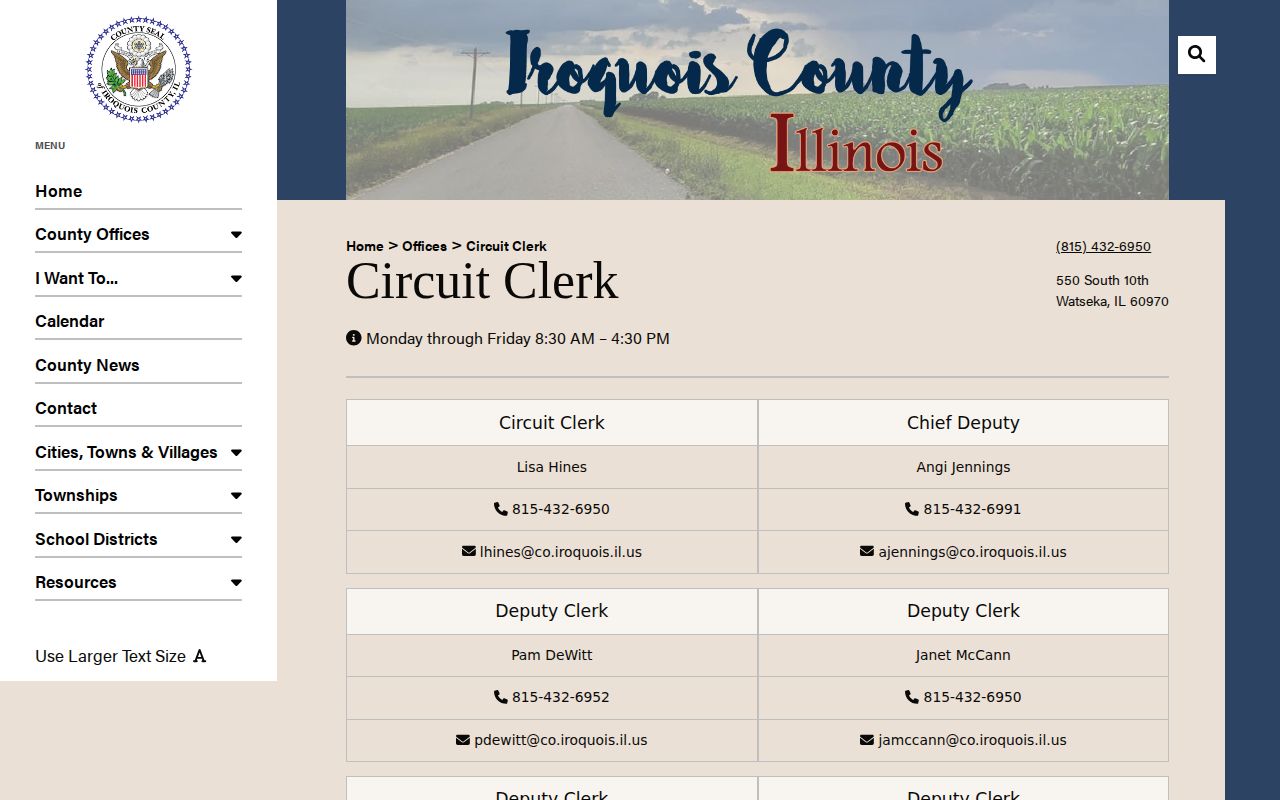
The page identifies the court-record custodian, while the Sheriff remains the custodian of the jail exit entry.
Iroquois County Release Record Law
Illinois FOIA, 5 ILCS 140, begins with a presumption that public records are open, but it also permits withholding or redaction under Section 7 and other laws. Jail records can contain private personal details, active law-enforcement material, medical facts, security information, and victim or witness data. Juvenile, sealed, and expunged material may also be restricted. A response should identify the basis for a denial and release reasonably segregable nonexempt parts rather than treating every page as indivisible.
Retention is a separate issue. Iroquois County has not published a retention rule for names on a released roster because no such official roster was found. Local government records are managed under approved retention schedules. If an old booking or release entry cannot be located, ask which jail-management system, identifiers, and Local Records Commission schedule were checked. The permanent property-receipt requirement is a specific exception supported by the jail inspection.
Expungement can direct qualifying police and court records to be erased, while sealing restricts public access without necessarily destroying every government record. Eligibility depends on the outcome and history under 20 ILCS 2630/5.2. The Illinois Courts publish statewide forms, but the Circuit Clerk cannot give legal advice. A missing online docket or image is not fresh evidence of release. It may reflect sealing, expungement, juvenile confidentiality, a vendor limit, or a simple search mismatch.
When records conflict, use each custodian for the fact it owns. The Sheriff's underlying event entry is strongest for the physical exit. The filed court order is strongest for legal authority. A receiving agency is strongest for continued custody. Preserve the official labels and timestamps instead of forcing the records into one broad description.
Iroquois County Release Turnover
Historical county figures show why a live roster is a poor archive. The jail reported 558 adult bookings in 2021, an average daily population of 19, and an average stay of 18 days. These figures are dated context, not a present population or a count of people released to the community. Short stays can begin and end between roster snapshots, which is why an event log is stronger than comparing two lists.
Iroquois Pretrial Release Counts
County Board minutes counted 204 pretrial detention releases from September 18, 2023 through May 2024, including 135 during the first five months of 2024. This is a defined local category, not a full release list. It should not be added to transfers or other exit types to create an annual total. The legal proof remains the court order, while the jail timestamp proves the physical exit.
Iroquois County Release Transfers
The same 2021 county report listed 18 transports to IDOC. That number gives a local reason to separate community exits from custodial transfers. A person transported to IDOC has been released from county control but remains confined by the state. Search the IDOC record after intake instead of treating absence from the county jail as a community return.
Find Iroquois County Released Inmates
No official Iroquois County released-person roster, rolling 24-hour feed, 72-hour feed, or archive was located during the research sweep. Begin with the jail and court rather than relabeling a current-custody list. A released person commonly drops off a live roster because that tool answers who is held now, not who left in the past.
- Call the jail and ask about the specific booking's exit date, time, authority, type, and receiver.
- Search the Circuit Court docket and obtain the order nearest the exit.
- If the record says IDOC, allow for intake processing and search the state system.
- If probation follows, use the court order and County Probation, since no public probationer search exists.
- Use VINE for an alert or current relay status, not as a certified history.
- Follow federal or immigration channels only when the jail or court facts point there.
- Send a narrow records request if phone or online results leave a gap.
IDOC Search for Iroquois Releases
The Illinois Department of Corrections search matters only if the person entered state custody. Search with an IDOC number when available. Otherwise use the last name and refine the match with birth date, middle name, physical details, conviction, and committing county. An old state profile is not proof of current imprisonment, and IDOC silence says nothing about a person released from the county jail without a state sentence.
| Search or profile field | How to use it |
|---|---|
| IDOC number | Best exact state identifier |
| Last name and birth date | Find and distinguish possible matches |
| Photograph and description | Check identity before reading the result |
| Facility and status | Assess present state custody |
| Projected MSR date | Prospective move from prison to supervision |
| Projected discharge date | Prospective end of the sentence and supervision structure |
The official IDOC search is shown below.
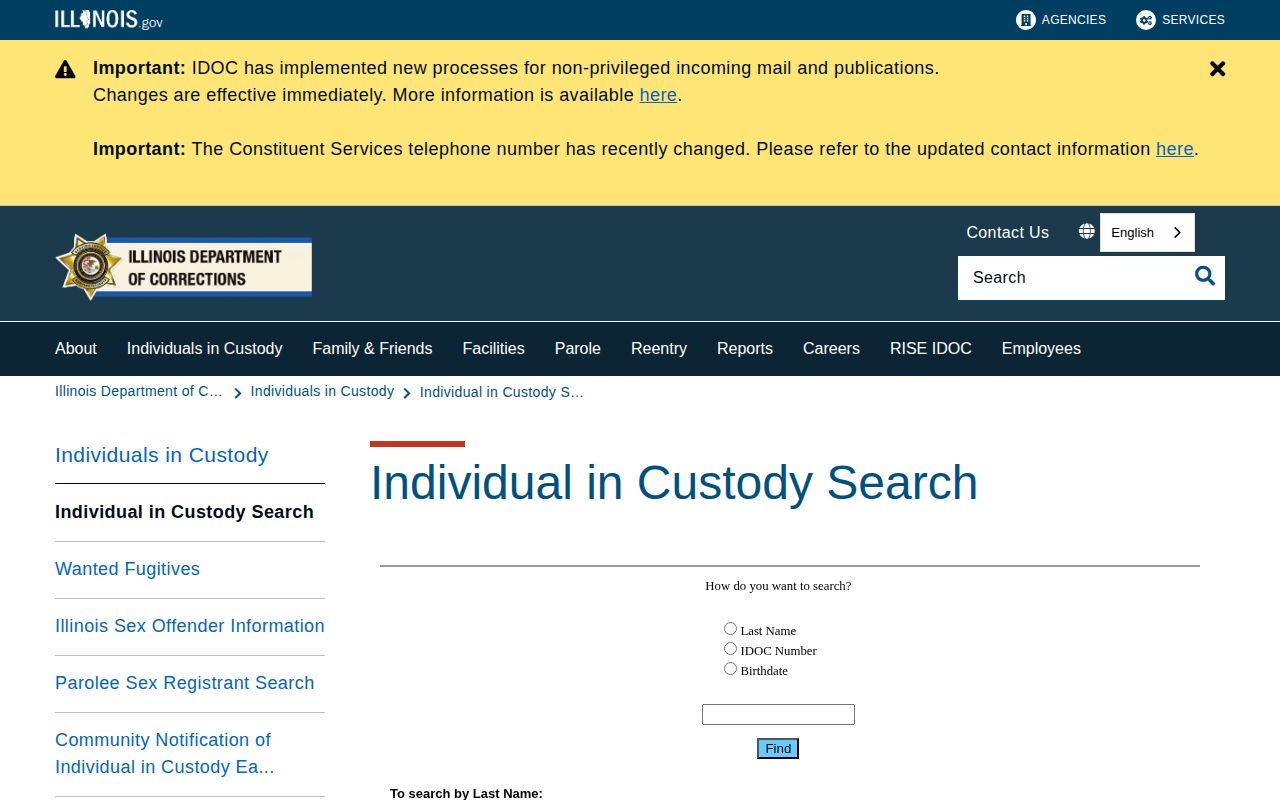
Its state profile can document an IDOC path, but it does not replace the county release log or court order.
Iroquois Release Property Receipts
The permanent signed itemized property receipt is a distinctive Iroquois County release record. The 2024 inspection standards state that staff inventory and return property before discharge, transfer, or release. If a third party receives property, the detainee must authorize that pickup and the recipient must sign. The personal file can also contain itemized cash, valuables, and expenditures.
When property is disputed, identify the booking in writing and ask that the release entry, receipt, and any third-party authorization be preserved and reviewed. Attach a relevant order or receipt if available. This record can show what was acknowledged at the exit, but it does not explain the court disposition. Keep the property question separate from the legal basis for release.
Getting Home After Iroquois Release
SHOW BUS lists the Iroquois County Courthouse, on the same campus as the jail, as a limited Watseka stop. The service publishes advance reservation rules and fares. That listing does not promise a jail pickup, a ride aligned with an exit time, or evening service. Confirm actual community release first, then call the jail and the transit provider before making travel plans.
Iroquois Release Recovery Resource Card
A locally created Recovery Resource Card has also been handed to people leaving the jail, according to June 2025 coalition minutes. Its QR code points to Tip the Scale contacts. The same minutes mention an Iroquois Mental Health Center reentry role, and later minutes describe funding for a recovery-reentry counselor. These are navigation resources, not guaranteed placements or services.
Federal Iroquois Release Checks
Federal paths are separate. The BOP locator covers many sentenced federal prisoners from 1982 onward and may show “Released” with a date. “Not in BOP custody” is broader and does not rule out court custody, supervised release, or another custodian. A federal pretrial detainee may remain under USMS control and never enter the BOP sentenced-prison system.
ICE's locator covers many current detainees and some people released from ICE within the prior 60 days, with exclusions and lag. Search by the nine-digit A-number and country of birth or exact biographical details. A county entry that says ICE is a transfer, not a community release, and a missing ICE result proves neither release nor removal.
| Person's path | Best first proof |
|---|---|
| County jail exit | Sheriff release entry |
| Still held at county jail | Current jail confirmation |
| State prison or MSR | IDOC profile and records |
| Federal sentenced custody | BOP locator |
| Federal pretrial custody | Federal court and USMS |
| Immigration custody | ICE locator and information line |
Iroquois Release Financial Claims
Iroquois County Ordinance 2007-14 authorized reasonable deductions from inmate funds for medical costs and allowed discretionary civil recovery from convicted inmates to the extent of ability to pay under 730 ILCS 125/20. This does not establish that any named person owes money. It does show that leaving custody does not necessarily resolve every county financial claim.
Ask the office that issued a charge for the account record and authority. Do not infer a balance from a booking record or from the ordinance alone. Court fees, jail account entries, and FOIA copy charges are separate subjects, each held by its own custodian.
Iroquois County Release Facilities
The Iroquois County Jail is the only adult county detention facility identified locally. System pages cover the other paths because no IDOC prison, BOP institution, or ICE detention center was confirmed inside the county. A county jail release may lead to the community or another custodian. IDOC releases appear through state records; federal and immigration releases require their own locators and underlying files.
- Iroquois County Jail: county exit record and court order.
- Illinois Department of Corrections: statewide prison and MSR records.
- Federal Bureau of Prisons: sentenced federal custody and release dates.
- ICE Detention Network: current or recent immigration custody with limits.
Public Record Search
Sponsored Results