
Iroquois IDOC Release Path
People sentenced from Iroquois County may first leave the county jail on an IDOC transport. That event ends Sheriff custody while imprisonment continues. IDOC chooses the receiving institution statewide, so the county of conviction does not identify the prison. Search the state system after intake time has passed and keep the county booking number, court case number, and IDOC number separate.
A later state-prison release can lead to mandatory supervised release, commonly called MSR, or to final discharge when the full sentence and supervision structure ends. IDOC supervises MSR. The Illinois Prisoner Review Board sets or reviews conditions and handles specified revocation and parole matters. A state profile may remain visible after prison release, which makes it useful for history but not conclusive proof of current confinement.
Confirm an Iroquois IDOC Release
Open the IDOC Individual in Custody Search and use the most exact identifier available. The direct application accepts last name, IDOC number, or birth date in month-day-year format. Compare the photograph, full identity, IDOC number, committing county, offense, status, and location before choosing a result. Maintenance gaps and name variants can cause a missed match.
- Start with the IDOC number when known.
- Otherwise search the last name and refine with birth date.
- Match the committing county and conviction details.
- Read current status and location with both projected date fields.
- Request the release record if the public profile is ambiguous.
- Check PRB or IDOC supervision records for the later supervision stage.
The official IDOC offender search is the correct statewide starting point.
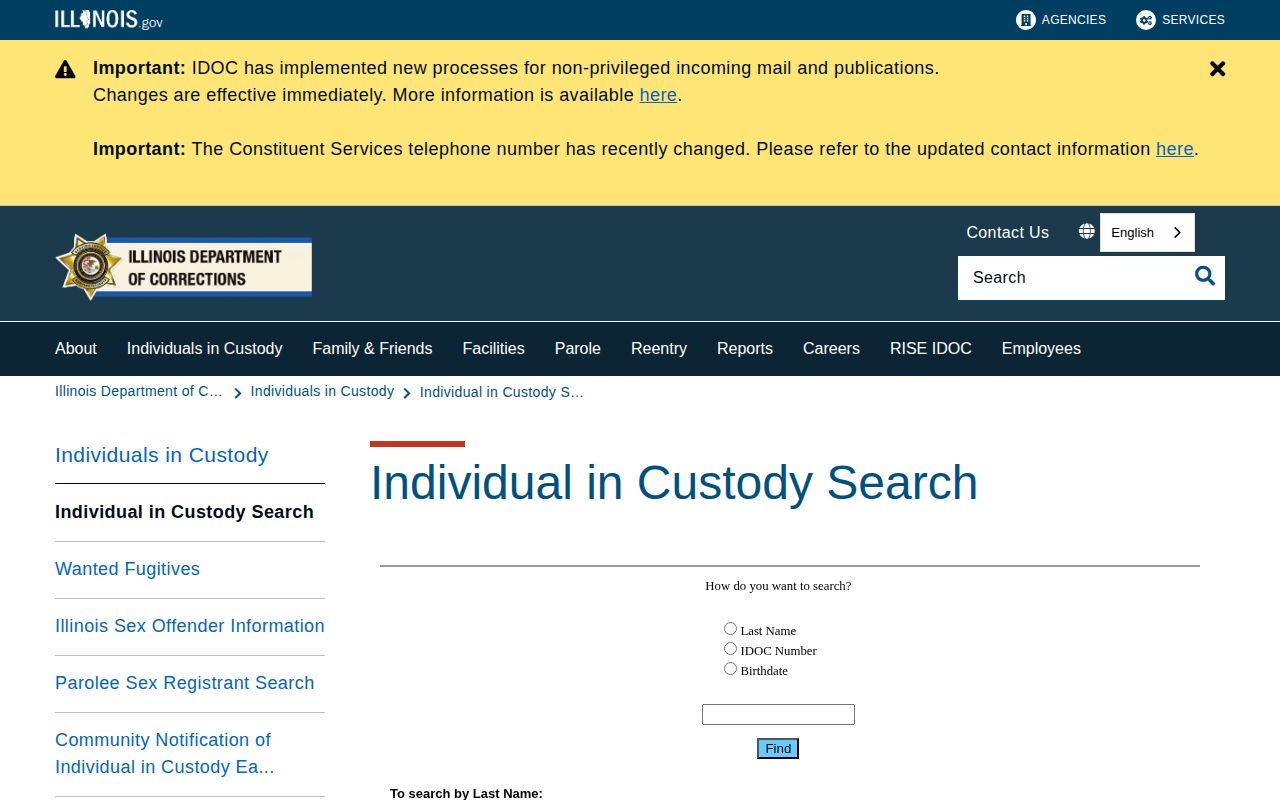
The form is a state-prison source and does not document a county-only bond or pretrial release.
Iroquois IDOC Search Fields
IDOC profiles combine identity, custody, sentence, and prospective information. Read them as a group. One projected date cannot prove that a person walked out, and an old profile cannot prove that the person remains confined.
| Field | Meaning |
|---|---|
| IDOC number | Stable state corrections identifier |
| Status and location | Current state record at the access time |
| Committing county | Helps match the Iroquois County case |
| PROJ MSR DATE | Expected move from prison into supervised release |
| PROJ DISC DATE | Expected end of sentence and supervision structure |
| Sentence and offense | Identity and calculation context |
| Photograph | Identity aid, not proof of current custody |
A status showing release should be paired with the event record or supervision information. A location marked in transit is not community release. Save the profile access date because credits, holds, violations, and status changes can update it.
IDOC Projections for Iroquois Cases
PROJ MSR DATE anticipates movement from prison to MSR. PROJ DISC DATE anticipates completion of the wider sentence and supervision structure. Neither is an actual exit timestamp. Sentence calculation begins with the judgment, presentence custody credit, concurrent or consecutive terms, the law for the offense date, credits actually awarded, credits revoked or restored, and the MSR term.
Illinois does not impose one simple percentage on every sentence. Section 3-6-3 contains ordinary-credit rules and restrictions that can require 75, 85, or 100 percent service for specified categories. Earned Sentence Credit is discretionary. IDOC says initial consideration generally requires more than 60 days in its custody and no statutory exclusion, but eligibility creates no promise of an award.
Note: A projected date can change and should not be used as proof that an IDOC release occurred.
Iroquois IDOC Release Records
The master file can contain sentence-calculation sheets, credit revocation or restoration records, parole agreements, violation reports, release checklists, notification of release date, MSR preparation material, PRB notices, warrants, detainers, release packets, and photographs. Ask for the specific items that answer the question instead of requesting an undefined complete file.
Useful wording is: “For the person’s IDOC number, please provide the notification of release date, release checklist or packet, sentence-calculation sheet, status-change record showing release to MSR or discharge, final-discharge material if present, and the most recent releasable release identification photograph. Electronic production is preferred. Please provide segregable records after lawful redaction.”
A public profile screenshot is not a certified master record. The calculation sheet and notification of release date are stronger for a disputed projection. PRB material is requested from PRB when that board is the custodian, while the Circuit Clerk supplies the judgment and mittimus from the Iroquois County court case.
IDOC also maintains a special search for qualifying statutory early-credit releases. It is not a full list of everyone leaving Illinois prison. The research found that a qualifying entry may be posted shortly after release and may remain during the first MSR year or until a return to custody. Absence from that tool says nothing about an ordinary release. Use it only as a supplemental check, then confirm the event through the state profile, notification of release date, and release packet. IDOC photograph policy also calls for an image at release or discharge and keeps automated images retrievable, so a focused request may seek the latest releasable release identification photograph with the event record.
IDOC Records Office Contact
IDOC is a statewide system, not a physical Iroquois County facility. Direct records requests to the state office rather than the county jail once IDOC accepted custody.
1301 Concordia Court
P.O. Box 19277
Springfield, IL 62794-9277
DOC.FOIARequest@illinois.gov
217-558-2200, extension 4166
Fax: 217-558-5612
Illinois FOIA generally sets five business days for a noncommercial response and permits a written extension of up to five more business days for statutory reasons. Ask for electronic records and advance notice of costs. The IDOC schedule cited in the research lists 59 cents for an 8.5-by-11 color page. Exempt material may be redacted while segregable content is produced.
Iroquois MSR and Final Discharge
Most modern determinate sentences move to MSR on the date calculated by IDOC. PRB does not independently choose the release date for most such cases. It sets and reviews conditions, while IDOC supervises. Legacy indeterminate C-number cases for older offenses use discretionary PRB parole review, and youthful parole is a separate statutory route with its own eligibility rules.
A violation can lead to a new county jail episode, a preliminary hearing, a final revocation decision, and IDOC recalculation. That later custody does not erase the original prison release. Final discharge occurs later and ends supervision. A PRB early-final-discharge decision, when granted after case review, is different from release through the prison gate.
IDOC’s FY2023 fact sheet counted 29 supervised people residing in Iroquois County. That dated figure is local context, not a live roster. Use the state profile and case-specific record to verify one person.
Iroquois County-to-IDOC Transfers
Iroquois County reported 18 transports to IDOC in its 2021 jail data. The dated count shows why a person’s disappearance from the local jail cannot be labeled community release without checking the destination. The Sheriff release entry proves that county control ended. IDOC admission proves that state imprisonment began.
If no state match appears at once, recheck spelling, birth date, intake lag, and the county record’s receiving label. A federal or other-county transfer will not appear in IDOC. The Iroquois County release verification path explains how the Sheriff entry, court order, and receiving record fit together.
When intake is delayed, preserve the Sheriff’s transport date and the filed mittimus. Those records establish the handoff while the state profile is still being created. Later IDOC admission and location fields complete the custody chain.
Public Record Search
Sponsored Results