
Iroquois Federal Release Path
A person may leave Iroquois County Jail because a federal writ or U.S. Marshals pickup ends local control. That is a custodial transfer, not a release to the community. The Sheriff’s release entry should identify the receiving authority. The federal court docket then explains the order, while the receiving agency establishes what happened next.
BOP mainly covers people serving federal prison sentences. It is not the complete record for every federal arrest, prosecution, or pretrial detention. USMS controls many federal pretrial detainees and can place them in contract facilities. A person may be released by a federal court without entering a BOP institution. Search the correct system for the stage of the case.
Confirm an Iroquois BOP Release
The BOP inmate locator covers federal prisoners from 1982 to the present. Search by register number when it is known. A register number is more reliable than a name. Otherwise, enter the legal name and compare age, race, sex, and any other returned identity fields. Save the access date because the record can change.
- Check the Iroquois County release entry for a federal receiver.
- Search BOP by register number or exact name.
- Compare identity fields before opening a result.
- Read status, release date, and facility or management location together.
- Use the federal docket for the legal order and supervision terms.
- Request the underlying federal record if the locator is unclear.
The official BOP inmate locator is the correct public search for its sentenced-prison population. A missing result does not establish a county release, since the person may be outside BOP scope or still in another authority’s custody.
Iroquois BOP Result Fields
Read the locator as a federal custody index. Each label has a limited meaning. The name and number help identify the record, while the status and date describe what BOP reports. They do not supply the whole criminal case or all post-custody conditions.
| BOP field or label | What it establishes |
|---|---|
| Register number | The federal prisoner identifier |
| Name and identity fields | Whether the record matches the person sought |
| Location | The BOP facility or management unit shown |
| Release date | The date reported for the end of BOP custody |
| RELEASED | The person is no longer in BOP custody as reported |
| IN TRANSIT | Movement within federal custody, not release |
| Community Corrections Management | Administration that may involve a halfway house or home confinement |
“Not in BOP custody” can describe release, transfer, court custody, or another status. Do not expand the label into a claim of unrestricted community freedom. A BOP release date also does not prove that federal supervised release ended.
Read Iroquois Federal Release Results
A past date paired with RELEASED and no facility generally establishes that BOP custody ended on the reported date. The federal judgment and docket should be checked for supervised release, which is court-ordered oversight after imprisonment. The U.S. Probation Office, not Iroquois County Probation, handles federal supervision.
IN TRANSIT means the person is moving within the federal custody process. It is not a release. A Community Corrections Management listing can reflect placement in or administration through a residential reentry center, often called a halfway house, or home confinement. Those settings remain part of the federal custody framework even when the person is outside a prison building.
Note: A BOP release date confirms one custodian’s endpoint and does not exclude supervision or custody by another authority.
BOP Records for Iroquois Cases
The public locator is an index rather than a certified release packet. For exact proof, request the record that states the custody endpoint and destination. Identify the person by full name, register number, birth date, and approximate release date. Ask for releasable sentence, designation, transfer, release, and community-corrections records that answer the question.
A focused request can say: “For register number [number], please provide the releasable record showing the date and type of release from BOP custody, the facility or Community Corrections Management office responsible at release, and the destination or transfer authority if recorded. Electronic production is preferred. Please redact exempt information and provide all reasonably segregable portions.”
Federal records may be requested under the Freedom of Information Act, while a person seeking their own protected record may also need the Privacy Act process. Follow current BOP instructions for identity verification, authorization, fees, and submission. A third party may receive less information because privacy exemptions apply.
Federal Prison System Contact
The Federal Bureau of Prisons is a national system, not a physical facility in Iroquois County. No BOP institution was identified in the county. Use the locator and the contact for the institution or Community Corrections Management office shown in the record. For a formal record, use BOP’s current FOIA and Privacy Act channel.
Federal prison system
No BOP institution identified in Iroquois County
Use the official inmate locator and BOP contact directory
Confirm current records-office instructions before filing
Do not call the Iroquois County Jail for a later BOP release record once federal custody has begun. The Sheriff can document the original county exit and receiver. The federal custodian holds the later movement and release records. The federal court clerk holds the judgment and docket.
Iroquois USMS Custody Limits
USMS has no public historical name locator that works like the BOP search. Its Prisoner Tracking System includes prisoner processing and disposition data, but public confirmation generally comes from the federal court docket and an appropriate USMS FOIA or Privacy Act request. This gap is important when a person disappears from the county jail after a federal pickup.
A federal pretrial detainee can remain under USMS authority in a contract facility and never receive a BOP sentenced-prison profile. A judge can order release from that status. In that situation, BOP silence is expected and does not prove either detention or release. Use the federal case number, detention order, release order, and USMS record.
If Iroquois County records merely say “writ,” ask which authority took custody and whether the person was returned after the court event. A writ can authorize temporary movement for proceedings without ending the underlying state or local custody.
Iroquois BOP Record Verification
The strongest proof depends on the fact at issue. The Iroquois County Sheriff entry proves the end of local custody. The federal docket proves the judge’s order and sentence. BOP proves its own admission, placement, and release. USMS proves its prisoner handling. A receiving state or ICE record proves any later transfer.
The Iroquois County release verification path explains how to keep the local exit, legal authority, and next custodian separate. If sources conflict, record their exact labels and access dates. Do not replace “released,” “in transit,” or “not in BOP custody” with a broader phrase.
BOP Release Guidance for Iroquois
BOP’s official records guide explains why release labels require context and describes the scope of the locator.
The BOP locator records guide is the source for interpreting released results.
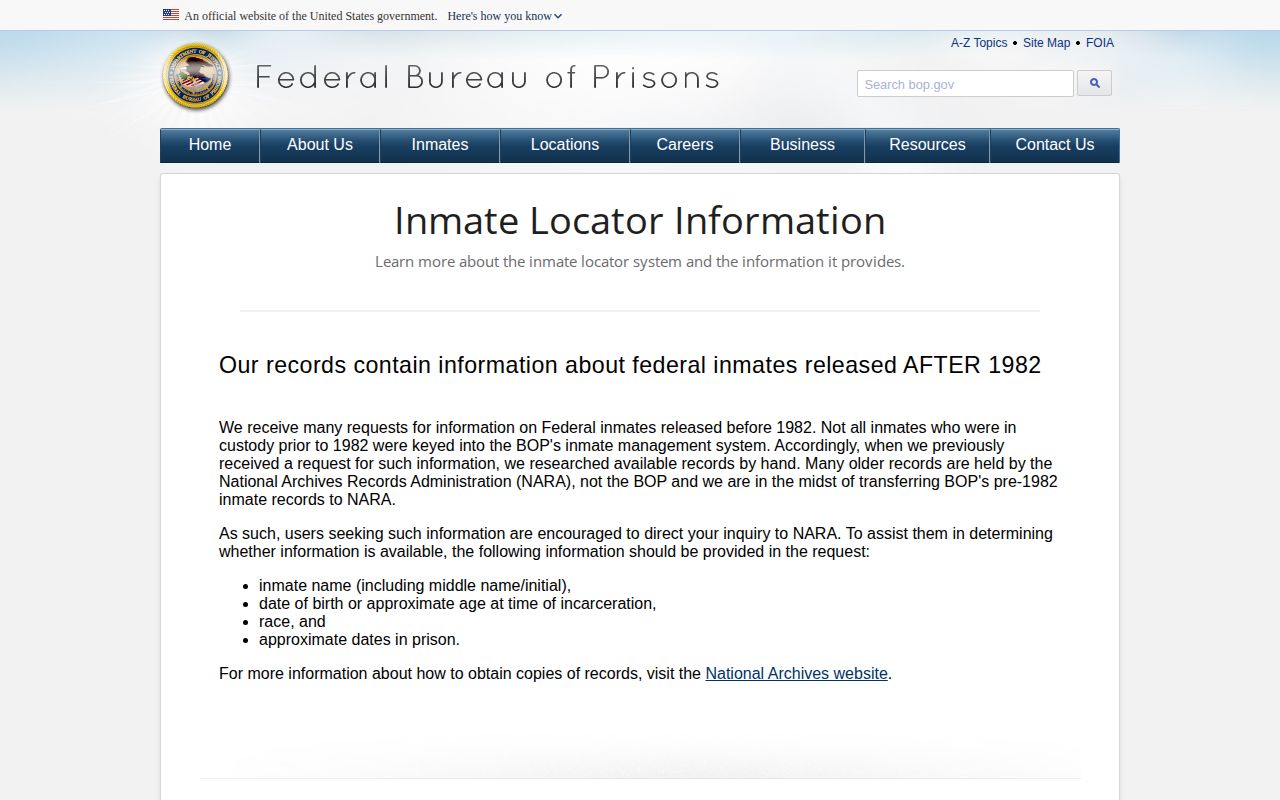
The guidance supports reading the release date as the end of BOP custody while checking separately for supervision or another custodian.
Public Record Search
Sponsored Results